
When Wittgenstein was Wrong
In his 1972 film Aguirre, the Wrath of God, Werner Herzog - with the maniacal and capricious help of actor Klaus Kinski - charts a man’s gradual descent into madness at the hands of the untameable, unknowable jungle. Lope de Aguirre, trailing a dying Spanish expedition through the Amazon basin in search of El Dorado, eventually finds himself isolated on a drifting raft surrounded by chattering monkeys and rotting corpses. Aguirre looks out at the vast, chaotic landscape of the jungle and proclaims a terrifyingly rigid, sovereign order. He views history, people, even nature itself as forces he can bend to his will and announces that he will marry his own daughter and found the most pure dynasty the world has ever known. Herzog shows us that Aguirre seeks to map an unyielding, geometric fantasy of control and absolute law onto the dynamic, sprawling reality of the jungle. A reality that does not care about its borders, his goals, his dreams, and will shortly swallow him whole.
It is a striking manifestation of a persistent human temptation: the desire for the glass palace. The pathological belief that if we could only design a system of sufficient formal perfection, sufficient exactness, sufficient precision, then the messiness of human experience could be permanently subdued and brought to heel.
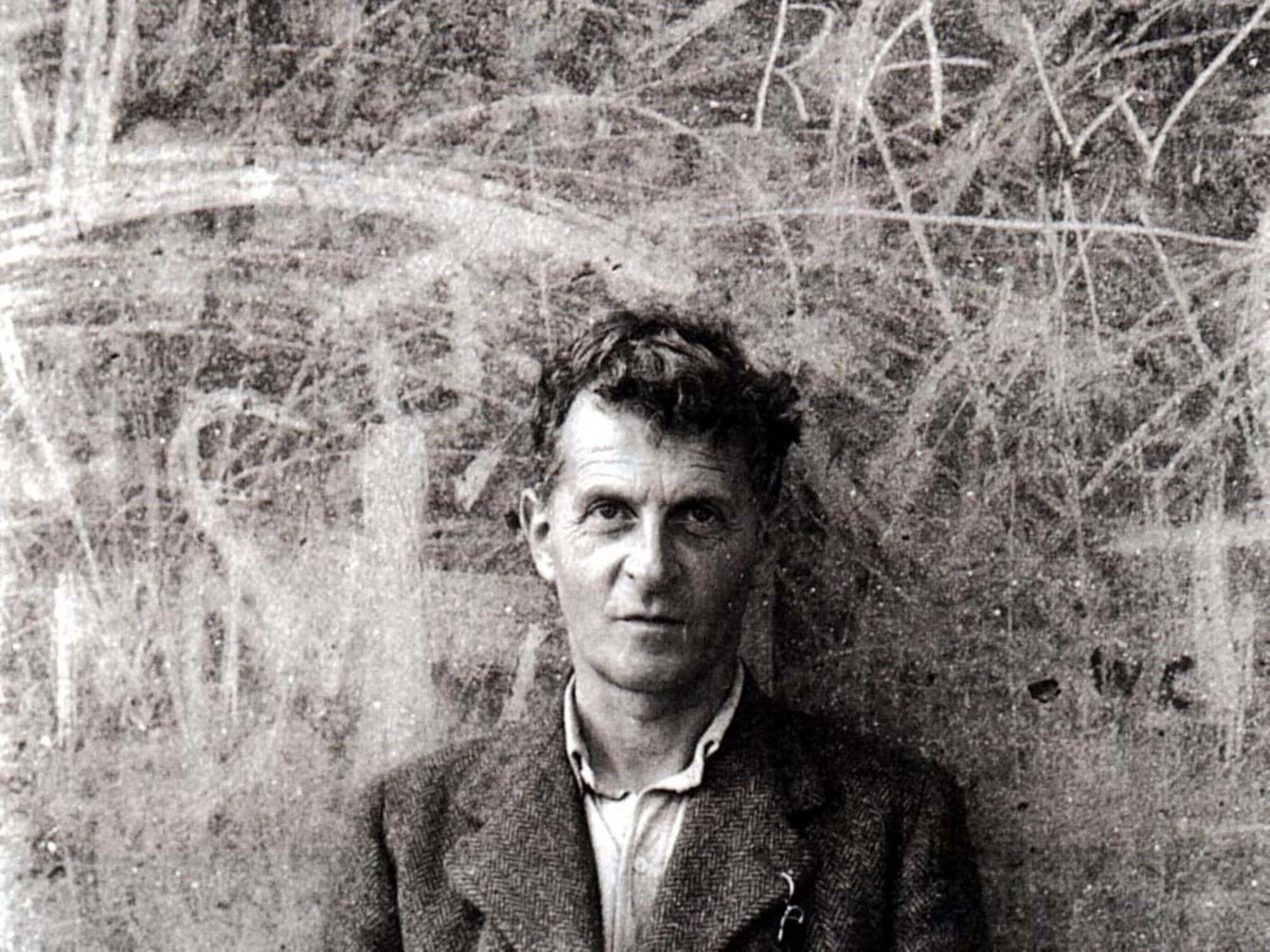
Before he changed the course of modern philosophy, Ludwig Wittgenstein set out to build exactly this kind of edifice.
Wittgenstein produced two distinct masterpieces that completely revolutionised his field, where the second functioned as a methodical, unrelenting dismantling of the first. The arc of his thought was not a gradual evolution, but a radical recantation in which he constructed a flawless palace of pure logic, watched it shatter against ordinary life, and then spent his remaining years learning how to walk on the uneven ground below.
Wittgenstein’s first and only book, the Tractatus Logico-Philosophicus, was completed in the trenches of the First World War. In this text, we see the early Wittgenstein being captivated by the absolute purity of logic, a passion shared with Bertrand Russell and Gottlob Frege, two major inspirations and mentors and huge figures in the philosophical landscape of the time. Wittgenstein looked at the vast history of philosophy, with its interminable, circular debates over ethics, metaphysics, and the nature of the cosmos, God, and the soul, and concluded that these problems were not really philosophical problems at all, - at least not in the traditional sense - but rather simple structural errors or linguistic confusions.
"The book deals with the problems of philosophy, and shows, I believe, that the reason why these problems are posed is that the logic of our language is misunderstood."
— Tractatus Logico-Philosophicus, Preface
Wittgenstein’s solution was the Picture Theory (Abbildungstheorie). A sentence was a logical picture of a state of affairs. As he stated in Proposition 4.01,
"A proposition is a picture of reality."
Words, then, were names that corresponded directly to simple objects in the world, and the structure of the sentence mirrored the logical form of the fact it represented. Wittgenstein believed that language possessed a single, essential essence, which was to state empirical facts. It was the ultimate, frictionless user interface for human thought.
This perspective led to an uncompromised conclusion. If a proposition did not mirror a physical fact in the world, it was completely devoid of cognitive sense. It was unsinnig, meaning nonsense. In Proposition 4.003, Wittgenstein argued that most of the propositions found in philosophical treatises are entirely nonsensical philosophically speaking. Because things like ethics, religious experience, aesthetics, and the meaning of life could not be reduced to logical pictures of physical facts, they could not be spoken about within the boundaries of philosophical sense. Instead, they belonged to the mystical. For Wittgenstein, this meant that in philosophy the universe was split cleanly between what could be stated clearly and what had to be passed over in absolute silence.
"The limits of my language mean the limits of my world."
— Tractatus, Proposition 5.6
Believing he had solved all philosophical problems, Wittgenstein acted with characteristic finality. He gave away his massive inherited family wealth, turned his back on Cambridge, and vanished into the rural villages of Austria to teach elementary school children. This didn’t play out quite how he imagined it would.
Faced with actual primary school children in those mountain villages, his geometric ideals began to look like an illusion. Children do not learn language by mapping abstract logical names onto isolated physical objects in the manner of a mathematical proof. That is a rigid view of communication that he later traced back to St. Augustine at the very beginning of his Philosophical Investigations. Instead, the children learned words through action, through shared practices, and through human interactions deeply entangled with their immediate desires and daily tasks. Context dictated everything, and the meaning of words was rooted not in some essence but in their use.
A moment of breakthrough for Wittgenstein occurred on a train ride with his good friend Piero Sraffa, a political economist also at Cambridge. As the two men debated, Wittgenstein asserted his view that a proposition and the reality it represented must share an identical logical form. Sraffa made a classic Neapolitan gesture of brushing his fingertips outward from beneath his chin, a cultural signifier of utter contempt, and asked: "What is the logical form of that?"
The gesture had undeniable meaning, yet it pictured nothing. It mirrored no empirical state of affairs. Its significance was entirely dependent on a complex, fluid web of human culture and social relations. What mattered here was not logical structure, but use. Wittgenstein realised he had himself been caught in the grip of an illusion. He needed to come out from under that illusion and find a new footing.
"We have got on to slippery ice where the conditions are ideal because there is no friction, but also, just because of that, we are unable to walk. We want to walk: so we need friction. Back to the rough ground!"
— Philosophical Investigations, §107
This realisation forced Wittgenstein to trade the mirror or model of reality for the tool chest, shifting his entire perspective toward experimenting with language as a lived, social medium. In the Philosophical Investigations, Wittgenstein abandoned the search for a hidden, universal essence of language and explicitly recanted the idea that the primary function of words was simply to name objects.
"For a large class of cases... the meaning of a word is its use in the language."
— Philosophical Investigations, §43
To explain this, he pointed to a simple toolbox containing a hammer, pliers, a saw, a screwdriver, glue, and a ruler. Wittgenstein points out that the real, lived functions of words are as diverse as the functions of these physical objects. It is absurd to claim that the essence of all these items is the same simply because we call them all tools. A hammer strikes, glue connects, and a ruler measures. Their utility is defined entirely by what they do within a specific human practice. Words work in precisely the same way - they are put to use.
To capture this open, dynamic nature of communication, Wittgenstein introduced the concept of the language-game (Sprachspiel). Language was not a frozen mathematical grid, for it was an active, evolving form of life (Lebensform). Human beings played different games with words depending on their shifting social contexts. They told jokes, gave military commands, wrote poetry, formulated scientific hypotheses, prayed, and gossiped. Each of these activities possessed its own unique set of rules, boundaries, and internal logic. An ace is high in one card game and low in another, and neither status represents its true definition or its true essence. The value of the card is produced entirely by the game that the players have voluntarily agreed to play.
When we look across all these diverse human activities, Wittgenstein shows us that they do not share a single, universal feature that makes them all language. Instead, they are connected by a network of overlapping similarities, which he termed a family resemblance (Familienähnlichkeit).
"Don't say: 'There must be something common, or they would not be called "games"'— but look and see whether there is anything common to all... don't think, but look!"
— Philosophical Investigations, §66
If we think of a family's portraits, we might see that the father and son share a certain shape of the jaw, the daughter might inherit her mother's eyes, and the cousins might share a specific posture. There is no single genetic feature present in every single individual, yet the family resemblance is palpable and real. Language is a family of practices, held together not by a structural metaphysical spine, but by the overlapping threads of shared human lives. To understand any specific use case of language, we have to understand the language game at play and the way of living that it is part of.
This radical reorientation completely transformed how Wittgenstein understood the very purpose of philosophy, shifting its role to one of curating conceptual clarity. In his youth, philosophy was a grand, structural project, a ladder to be climbed to achieve a cosmic viewpoint outside of language. In his later work, philosophy shifted to become something much more humble, intimate, and therapeutic.
For the later Wittgenstein, philosophical problems were not deep, objective truths waiting to be uncovered by logic. Instead, he viewed them as conceptual illnesses. They were knots in our thinking produced when language wrapped around itself, or when thinkers accidentally mistook a rule from one language-game for an absolute truth about reality.
"Philosophy is a battle against the bewitchment of our intelligence by means of our language."
— Philosophical Investigations, §109
Human beings, Wittgenstein claimed, became trapped by their own metaphors, chasing chimaeras because they pull words away from the everyday contexts where those words actually do honest work. The task of the philosopher is no longer to construct a grand metaphysical palace. The task was simply to untangle the knots and to clear away the conceptual confusion that kept human thinking captive. It was an act of care, a clearing of the sight.
"What is your aim in philosophy?—To shew the fly the way out of the fly-bottle."
— Philosophical Investigations, §309
The fly inside the bottle bumps up against the clear glass over and over again, exhausted, desperate, and entirely blind to the opening just above its head. It was trapped by the very transparency of its environment. By examining Wittgenstein’s trajectory, however, we see that clarity is not achieved by escaping into a sterile palace of perfect concepts. Clarity is found when we finally let the system break, allowing ourselves to inhabit the tools we choose, the games we play, and the clumsy, unmapped ways we learn to think and be together.