
In The Backrooms: Philosophy and the Liminal
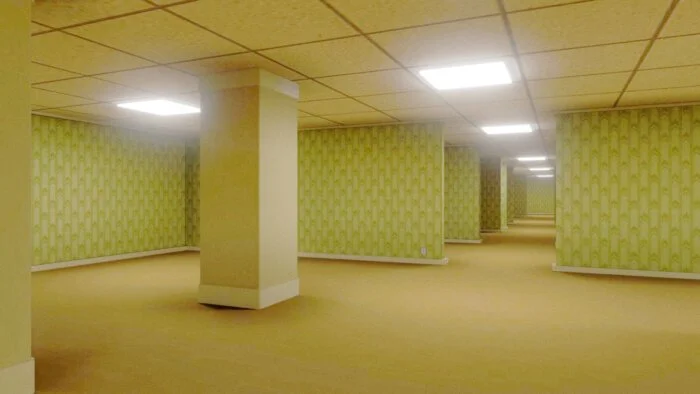
Slipping through the wall as if it were a banal mirage, you step into a maze of empty, yellow-hued corporatised corridors that seem to stretch on forever. You are immersed in the smell of acres of worn, industrial carpet, the biting glare of overhead strip lighting, and the muffled acoustics of cubicles and corridors. This is the baseline reality of the Backrooms, a memetic fragment of digital culture that has struck such a deep nerve that a major cinematic instantiation is already underway. Kane Parson’s take on The Backrooms will soon be released via A24, and it looks to be an arresting encapsulation of the bleak horror of the contemporary age. The persistent, low-level dread, the uncanny, and unsettling liminal spaces, the collapse of time, and of meaning. By paring away every familiar coordinate of our daily lives, these endless expanses of abandoned office space, with their dropped ceilings, and bureaucratic anonymity serve as a distressing metaphor for the modern institutionalised world. All of which is draped in an aesthetic, a vibe, a mood that has come to be termed Institutional Gothic.
The disorienting glitch or "no-clip" out of reality, represents a sudden failure to keep pace with the hyper-efficient rhythm of modern life. If you stop moving along the tracks of productivity, you drop entirely out of the structured, ordered world. Michel Foucault defines these marginal sites as heterotopias of deviation - the counter-spaces used by human culture to sequester individuals whose behaviour no longer aligns with the required economic norm:
"There are also heterotopias of deviation: those in which individuals whose behaviour is deviant in relation to the required mean or norm are placed. Cases of this are rest homes and psychiatric clinics, and of course prisons, to which one should perhaps add retirement homes, which are in some way on the borderline between the heterotopia of crisis and the heterotopia of deviation."
— Michel Foucault, Of Other Spaces: Utopias and Heterotopias.
This spatial isolation relies on the brutal architecture of physical confinement. In Discipline and Punish, Foucault demonstrates precisely how spaces like schools, hospitals, factories, and prisons are deliberately partitioned, systematised, and standardised to categorise bodies, all in an attempt to maximise efficiency and facilitate observation. The Backrooms mimic and amplify late twentieth-century corporate aesthetics as its in the world of work we find the contemporary descendants of Foucault’s sites of control. The office is now the space of total enclosure, where the horizon of possibilities has been shut down entirely and all that remains is efficiency, productivity, and anonymity. The spatial form of these sites is designed for absolute regulation. Foucault highlights this historical convergence of our everyday structures:
"Discipline sometimes requires enclosure, the specification of a place heterogeneous to all others and closed upon itself. It is the protected place of disciplinary monotony... Its aim was to establish presence and absence, to know where and how to locate individuals, to set up useful communications, to interrupt others, to be able at each moment to supervise the conduct of each individual."
— Michel Foucault, Discipline and Punish: The Birth of the Prison.
The profound, suffocating silence of the pasty yellow corridors gives life to Foucault’s image, borrowed from Bentham, of the Panopticon. In Bentham's model, this prison’s power functions because the central tower is visible to all those incarcerated in the outer ring, while the guards remains hidden and obscured.
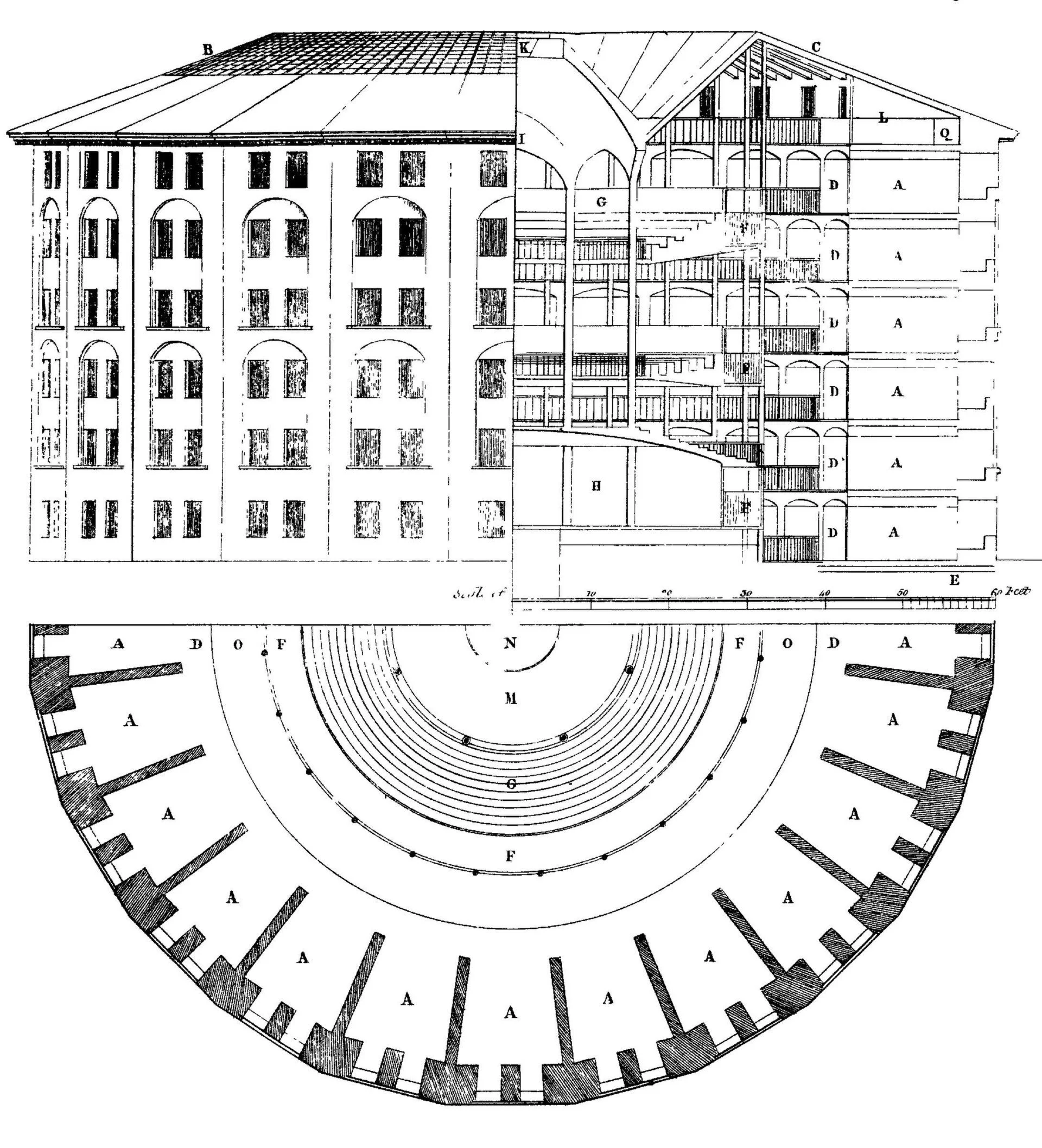
The inmate can never verify if they are being watched, so they must assume they are under observation at all times. The Backrooms take this anxiety to its logical conclusion. Here, the tower itself is completely empty. The authority figure has vanished, yet the architecture continues to police the occupant, who must navigate the silence under the permanent assumption that any sound will alert an imminent threat. Power is fully disembodied:
"He who is subjected to a field of visibility, and who knows it, assumes responsibility for the constraints of power; he makes them play spontaneously upon himself; he inscribes in himself the power relation in which he simultaneously plays both roles; he becomes the principle of his own subjection."
— Michel Foucault, Discipline and Punish: The Birth of the Prison
Rows of empty partitions, dead light switches, and corridors that lead only to more corridors shift the initial paranoia into a profound feeling of, in Sartre’s words, “…abandonment, anguish, and despair”. In these spaces we must act without hope. There is no boss, no worker, and no system left to serve. Only the shell remains as everything has become surface. This space is what Jean Baudrillard calls a simulacrum, a hyperreal environment composed entirely of the symbols of office life but that have completely detached from any actual productive labour or deeper significance. We are left wandering through a hollow imitation, a desolate landscape of signs that have outlived their meaning:
"Simulation is no longer that of a territory, a referential being, or a substance. It is the generation by models of a real without origin or reality: a hyperreal. The territory no longer precedes the map, nor does it survive it. It is nevertheless the map that precedes the territory (precession of simulacra) that engenders the territory..."
— Jean Baudrillard, Simulacra and Simulation
These empty symbols stack up into an infinite accumulation, forming a Möbius strip of what Marc Augé calls non-places. Corporate transit zones stripped of human activity. Windowless office elevator banks, generic business parks, and identical executive hotel corridors that sit devoid of the meaning or significance required to be felt as true places.The occupant of The Backroom is now condemned to exist permanently within a liminal space, a permanent holding pattern that Jean-Paul Sartre captures in his play No Exit:
"So this is hell. I'd never have believed it. You remember all we were told about the torture-chambers, the fire and brimstone, the 'burning marl.' Old wives' tales! There's no need for red-hot pokers…"
— Jean-Paul Sartre, No Exit.
This endless transit zone, built out of corporate debris, has a fascinating historical precedent in the Arcades Project of Walter Benjamin. Benjamin became obsessed with the commercial architecture of Parisian shopping arcades, viewing them as a material collage that embodied the collective dreamworld of capitalist society. The Backrooms function as a contemporary, digital version of those dreamworlds, constructed from the remnants and ghosts of the corporate lifeworld:
"Our investigation proposes to show how, as a consequence of this form of production, the collective consciousness sinks into an ever deeper sleep, in order to dream a dream that repeats the past in a new way. In the dream in which each epoch entertains its successor, the latter appears wedded to elements of primal history."
— Walter Benjamin, The Arcades Project.
The low-level discomfort that many of us feel reveals a latent fear that contemporary life is now defined by those vast, labyrinthine institutions - rendered all the more opaque and intangible by their retreat into the datasphere. The real power of the Backrooms is how it exposes this spatial anxiety in its current incarnation. This, in turn, allows us to expose the shift into simlacrum, the cloud, and corporate monoliths as one that drains meaning and renders lives inert and hollow. As Ursula Le Guin tells us, the power of fiction is not that it tells us dragons are real, but that they can be slain. And so, too, can the horror of the Backrooms arm us against the faceless, valueless, corporate commodifying of humane existence.
Recommended Reading
Marc Augé, Non-Places: Introduction to an Anthropology of Supermodernity
Jean Baudrillard, Simulacra and Simulation
Walter Benjamin, The Arcades Project
Michel Foucault, Discipline and Punish: The Birth of the Prison
Michel Foucault, "Of Other Spaces: Utopias and Heterotopias"
Jean-Paul Sartre, No Exit